The most important rituals and ceremonies of the Andean world
Discover the most important Andean rituals: Pachamama offerings, coca leaf readings, flower baths, Ayahuasca and San Pedro ceremonies. Complete guide to authentic spiritual experiences in Cusco with Andean shamans.
Andean rituals and ceremonies are ancestral practices that have survived for thousands of years in the Peruvian Andes. These spiritual traditions connect human beings with nature, the apus (mountain spirits), and Pachamama (Mother Earth). In Cusco, the heart of the ancient Inca Empire, these rituals remain alive and attract thousands of travelers seeking an authentic and transformative spiritual experience.
What is the origin of Andean rituals?
Andean rituals have their roots in pre-Inca cultures that inhabited the Andes more than 5,000 years ago. These civilizations developed a deep spiritual connection with nature, creating ceremonies to give thanks, ask for protection, and maintain cosmic balance.
With the rise of the Inca Empire, these rituals became formalized and spread throughout the Tahuantinsuyo. The Incas believed in reciprocity (ayni) as a fundamental principle of life: to give in order to receive, to be grateful in order to be blessed. This philosophy remains at the heart of today's Andean rituals.
The Andean worldview
To understand Andean rituals, it is necessary to comprehend their worldview, which divides the universe into three worlds:
- Hanan Pacha: The upper world, where celestial gods, the sun (Inti), the moon (Killa), and the stars reside.
- Kay Pacha: The world of here, where human beings, animals, and plants live.
- Ukhu Pacha: The lower world, where the spirits of ancestors and telluric forces dwell.
Andean rituals seek to maintain balance between these three worlds, facilitating communication and energy exchange among them.
Who are the paqos or Andean shamans?
Paqos are Andean priests or shamans, guardians of ancestral spiritual knowledge. They are people who have been chosen by the apus or have inherited the gift from their ancestors to communicate with the spiritual world and perform sacred ceremonies.
Types of paqos
- Alto misayoq: These are the highest-ranking paqos, capable of communicating directly with the apus and performing the most important ceremonies.
- Pampa misayoq: They perform healing rituals, energy cleansings, and offerings to Pachamama.
- Paqo hampiq: Specialists in physical and spiritual healing through medicinal plants and ancestral techniques.
Authentic paqos are recognized by their communities and have undergone years of learning and practice. It is important to seek certified paqos or those recommended by responsible tourism agencies to ensure an authentic and safe experience.
Offering to Pachamama
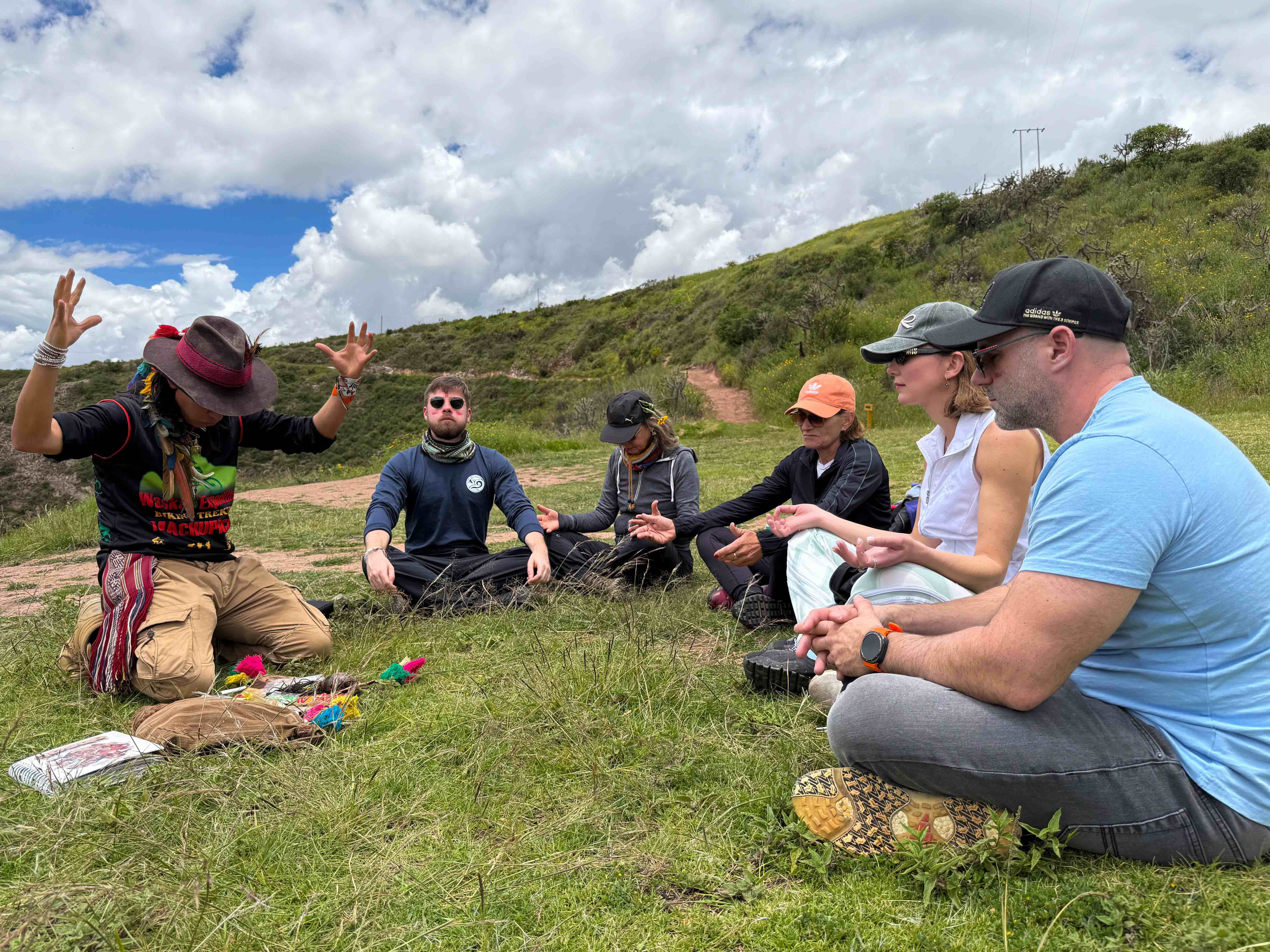
The offering to Pachamama, also known as "Payment to the Earth" or "Despacho," is the most important and common ritual in the Andes. It is a ceremony of gratitude and reciprocity with Mother Earth.
What is a despacho?
A despacho is a ceremonial bundle containing various symbolic elements that represent offerings to Pachamama and the apus. Each element has a specific meaning and is carefully selected by the paqo.
Traditional elements of the despacho
- Coca leaves: Sacred to Andean people, they represent communication with the spirits.
- Kinto (set of three coca leaves): Symbolizes the connection with the three worlds.
- Seeds and grains: Represent abundance and fertility.
- Sweets and candies: Symbolize the sweetness of life and good wishes.
- Chicha de jora: Sacred drink made from fermented corn.
- Wine or pisco: As a complementary liquid offering.
- Llama fat (unto): Represents vital energy and protection.
- Flowers and petals: Symbolize beauty and gratitude.
- Colored wool: Each color represents different aspects of life.
- Seashells: Connect with water and the origin of life.
How is the ceremony performed?
The ritual begins with the paqo preparing the sacred space and asking permission from the apus. Then, the offerings are assembled on special paper while prayers and energy blows are performed. Participants can express their intentions, gratitude, and requests. Finally, the despacho is burned or buried as an offering to Pachamama.
When is it performed?
Although it can be performed at any time of year, the most important dates are:
- August 1st: Beginning of Pachamama's month, when the earth is most receptive.
- All of August: Sacred month dedicated to Mother Earth.
- Solstices and equinoxes: Moments of energetic transition.
- Important personal dates: Birthdays, project launches, etc.
Coca leaf reading
Coca leaf reading is an ancient divination method practiced in the Andes since pre-Inca times. Coca leaves are considered sacred and serve as a means of communication with the spiritual world.
How does coca reading work?
The paqo selects a set of coca leaves and blows on them with the intention of the person consulting. Then, the leaves are cast onto a sacred textile and interpreted according to their position, shape, color, and how they fall on each other.
What can be consulted?
- Current life situation and spiritual path
- Physical and emotional health
- Personal and family relationships
- Work and projects
- Travel and important decisions
- Connection with ancestors
Coca reading does not aim to predict the future absolutely but rather offers guidance and clarity about the present moment and the possible directions life can take.
Flower baths
Flower baths are rituals of cleansing and energetic renewal that use flowers, aromatic herbs, and sacred water to purify the body and spirit.
What are they for?
- Energy cleansing: They eliminate negative energies and blockages.
- Attracting good luck: They open paths and attract opportunities.
- Spiritual renewal: They renew vital energy and mood.
- Emotional healing: They help release traumas and stagnant emotions.
Elements used
- Flowers of various colors: Each color has specific properties.
- Aromatic herbs: Rue, rosemary, basil, Santa María, among others.
- Spring water: Preferably from sacred sources.
- Rose petals: For love and relationships.
- White carnations: For purification.
How is it performed?
The bath is prepared with warm water where flowers and herbs are macerated. The paqo performs prayers and blows energy into the water. The person bathes completely while visualizing negative energies leaving and positive ones arriving. It is common to perform this ritual during the full moon or on special dates.
Ayahuasca and San Pedro ceremonies
Ceremonies with master plants such as Ayahuasca and San Pedro (Wachuma) are deep healing rituals that have been practiced for thousands of years in the Andes and the Amazon.
Ayahuasca
Ayahuasca is a sacred brew prepared with the Banisteriopsis caapi vine and Psychotria viridis leaves. It is used primarily in the Amazon jungle but is also practiced in some areas of the Andes.
- Produces visions and altered states of consciousness
- Facilitates deep emotional and spiritual healing
- Helps connect with the spiritual world and ancestors
- Requires prior preparation (diet, abstinence)
San Pedro (Wachuma)
San Pedro or Wachuma is a sacred cactus (Echinopsis pachanoi) traditionally used in the Andes. Its ceremonial use dates back more than 3,000 years, as evidenced by representations in the Chavín culture.
- Produces a gentler, more grounded experience than ayahuasca
- Facilitates connection with nature and the apus
- Performed during the day, usually in sacred places
- Promotes introspection and self-knowledge
Important considerations
These ceremonies should only be performed with experienced and trustworthy shamans. They are not recreational and require physical, mental, and spiritual preparation. Some medical conditions and medications are incompatible with these plants. It is essential to be well informed and choose responsible facilitators.
Andean wedding
The Andean wedding or Servinakuy is a traditional ceremony for uniting couples according to ancestral Andean customs. It is a ritual full of symbolism that celebrates the union not only of two people but of two families and their energies.
Elements of the ceremony
- Exchange of coca leaves: Families exchange coca leaves as a symbol of acceptance.
- Offering to Pachamama: A despacho is made asking for blessings for the couple.
- Hand tying: The paqo ties the couple's hands together with a colored ribbon.
- Toast with chicha: The couple shares chicha de jora as a symbol of union.
- Exchange of blankets: Families exchange traditional textiles.
Where is it performed?
Andean weddings are held in sacred places such as Sacsayhuamán, the Sacred Valley, Moray, or even at Machu Picchu. Many couples from around the world travel to Cusco to celebrate their union according to this ancestral tradition.
Andean spiritual healing
Andean spiritual healing encompasses various techniques and rituals used by paqos to restore physical, emotional, and spiritual balance.
Healing techniques
- Egg cleansing: An egg is passed over the body to absorb negative energies.
- Guinea pig cleansing: Ancestral technique for diagnosis and healing.
- Smudging: Sacred herbs are burned to purify the environment and the person.
- Laying on of hands: The paqo channels healing energy to the patient.
- Power blowing: The paqo blows sacred energy onto the person.
- Energy extraction: Blockages and dense energies are removed from the energy field.
When to seek spiritual healing?
People usually seek Andean healing when experiencing:
- Persistent bad luck or blockages in life
- Health problems with no apparent medical cause
- Emotional or spiritual imbalance
- Feeling of heaviness or negative energy
- After traumatic events or losses
- To prepare before important decisions
Recommendations for participating in Andean rituals
If you want to have an authentic experience with Andean rituals, keep these recommendations in mind:
Before the ritual
- Research well: Look for recognized paqos or shamans with good references.
- Contact specialized agencies: Companies like ours can connect you with authentic masters.
- Prepare mentally: Arrive with a clear intention and an open heart.
- Respect the guidelines: Some rituals require fasting or prior abstinence.
During the ritual
- Maintain a respectful attitude: These are sacred rituals, not shows.
- Follow the paqo's instructions: They know how to guide the ceremony.
- Stay present: Avoid distractions like your phone.
- Express your intentions: Communicate to the paqo what you seek or need.
After the ritual
- Integrate the experience: Take time to reflect on what you experienced.
- Rest: Rituals can be energetically intense.
- Maintain practices: Continue with small offerings or meditations.
- Be grateful: Gratitude is fundamental in the Andean worldview.
Frequently asked questions
1. Are Andean rituals religious?
Andean rituals are ancestral spiritual practices; they do not belong to any specific religion. They are based on the Andean worldview and connection with nature. People of any belief can participate with respect.
2. Is it safe to participate in ceremonies with master plants?
When conducted with experienced shamans and in controlled environments, these ceremonies are safe. However, they are not recommended for people with certain medical conditions or taking specific medications. Always consult before participating.
3. How much does an Andean ritual cost?
Prices vary depending on the type of ritual, the paqo's experience, and the location. A payment to the earth can cost between 50 and 150 dollars, while more elaborate ceremonies may have higher costs. Be wary of prices that are too low or too high.
4. Can I take photos during ceremonies?
Generally, photos are not allowed during rituals to maintain the sacred atmosphere. Some paqos allow photographs at the beginning or end. Always ask first and respect the decision.
5. Do I need to speak Spanish or Quechua to participate?
It is not necessary. Many paqos work with translators or guides who can explain everything in English or other languages. Specialized agencies usually offer bilingual services.
6. Can children participate in Andean rituals?
Children can participate in gentle ceremonies such as offerings to Pachamama or flower baths. However, ceremonies with master plants are restricted to adults.
7. When is the best time to do an Andean ritual in Cusco?
August is especially propitious as it is Pachamama's month. The solstices (June 21 and December 21) and full moon days are also important. However, rituals can be performed at any time of year.
8. How do I know if a paqo is authentic?
Authentic paqos are recognized by their communities, have years of experience, and do not make exaggerated promises. Seek references, read reviews, and contact serious agencies that work with recognized masters.
9. Can Andean rituals cure diseases?
Andean rituals work primarily on the spiritual and emotional plane. They can complement medical treatments but should not replace them. If you have health problems, always consult medical professionals.
10. Where can I experience authentic Andean rituals in Cusco?
Rituals are performed at various sacred places in Cusco such as Sacsayhuamán, Q'enqo, the Sacred Valley, Rainbow Mountain, and Machu Picchu. Contact agencies specializing in mystical tourism to organize your experience.